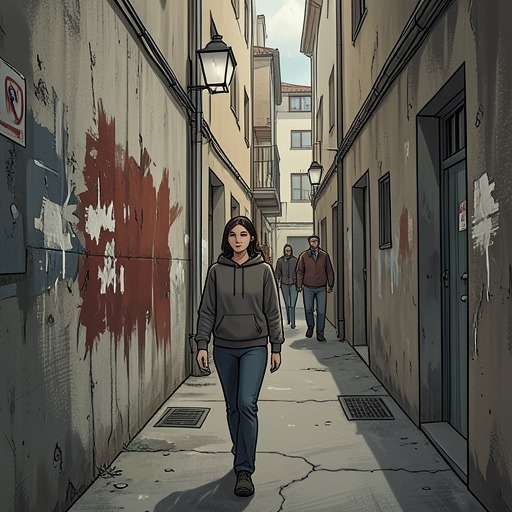
Ring parking lot confrontation and impromptu singalong
On the Come UpThe Ring parking lot confrontation and impromptu singalong turn an attempted exclusion into a public performance: after Crowns single out Brianna Jackson as the daughter of Lawless and challenge the meaning of her song, staff eject her alongside the people involved in the dispute. Brianna answers the expulsion by performing “On the Come Up” with the crowd, transforming a tense encounter into a moment of collective recognition while leaving her relationship with her aunt strained.
Background and Provocation
Brianna arrives at the boxing gym with Aunt Pooh and Scrap while a line stretches onto the sidewalk. They head directly to the entrance, as they usually do, but a man in a gray baseball jersey objects. His silver teeth and the gray worn by the men around him identify them as Crowns. Aunt Pooh challenges his insult, and Scrap warns him to reconsider.
The dispute changes when the man notices the chain Brianna wears, her father’s chain. He recognizes her as Lawless’s daughter and asks whether she is also the rapper behind a song with a line about not needing gray to be a queen. Aunt Pooh answers that Brianna claims no gang and can mean whatever she wants by her lyrics. The Crown says the song made them feel targeted and warns that Brianna could end up like her father. The allusion makes the exchange more than an argument about access or a lyric: her father’s death is invoked as a threat, and his chain becomes a visible link between Brianna and that history.
Ejection from the Ring
Aunt Pooh moves toward the Crown after his threat, and he advances toward her. The scene draws shouts, screams, and the attention of phones. Before the conflict develops further, bouncers Frank and Reggie intervene, separating Aunt Pooh and the Crown and ordering both sides to leave. Aunt Pooh protests that they were only trying to get inside so Brianna could battle, but Reggie says the venue does not tolerate gang activity.
The rule reaches beyond the people who confronted one another. When Brianna points out that she is supposed to battle, Frank tells her she cannot compete because her crew has brought what he calls gang trouble to the venue. She insists she has done nothing, but the staff’s decision treats association as sufficient grounds for removal. Her objection becomes sharper when she sees the crowd murmuring in agreement and hears Frank insist that they are being expelled because staff say so. The immediate stake is not only her safety or the confrontation outside the doors, but also the battle she came to perform in.
The Parking Lot Performance
As the crowd grows louder, someone plays “On the Come Up” from a car. Brianna takes up the song, beginning with its refrain, and the audience answers with the next line. When the hook arrives, people bounce and shout along, turning the parking lot into what she experiences as a mini-concert. A venue that has denied her the stage cannot prevent the song from gathering an audience just outside its doors.
Frank and Reggie return inside, shaking their heads, while people praise Brianna from every direction. She reads the response through her father’s standing in Garden Heights, thinking that if he was its king, she is its princess. The acclaim, however, does not settle the scene. Aunt Pooh glares at Brianna and heads toward the parking lot. When Brianna catches her arm and asks what is wrong, Aunt Pooh tells her that Brianna herself is the problem. She then leaves with Scrap, saying that Brianna can stay and that fame has gone to her head. Brianna is left alone outside after the confrontation, aware that the Crowns could still pose a danger and that she must get home carefully.
Image, Risk, and Performance
The incident becomes one of the moments through which Brianna’s music acquires a public meaning beyond her control. Supreme observes that phones were pointed at the group and anticipates a headline casting her as a “Ghetto Rapper” having a “Ghetto Encounter.” He advises her to play whatever role others assign her and use their assumptions to her advantage. His counsel frames the parking-lot scene as both an immediate conflict and material that could be turned into public attention; it also raises the question of who gets to determine what Brianna’s performance means.
That question returns when a television report identifies “On the Come Up” as a hit with young listeners and presents its violent lyrics as attacks on law enforcement. Later, in a Hot 105 interview, Hype brings up a petition to remove the song from Dat Cloud and asks Brianna to answer claims that it is anti-police and connected to a school riot. Brianna responds without hesitation that she is angry at those attacking her. When Hype calls her lyrics excessive and reads one line as an insinuation that she would kill police officers, she rejects that interpretation. She points out the gendered contrast in his reaction: her father rapped about such material at sixteen without drawing the same response. The parking-lot performance thus anticipates a broader struggle over how lyrics are turned into evidence about their author, particularly when the artist is a sixteen-year-old Black girl.
From Assigned Role to Self-Definition
Supreme’s advice to play a role carries a personal history as well as a commercial strategy. He later tells Brianna that Law was not a gangster when they met, but had been working to support Brianna’s mother and brother after church choir. Supreme says he encouraged Law to rap about the street and associate with the Garden Disciples to appear authentic, but that Law took the role too seriously. He urges Brianna to play the role without becoming it, presenting her career as a chance to avoid repeating her father’s path. Brianna recognizes that Supreme sees her partly as a second chance to redo what happened with Law.
The pressure to perform a marketable identity echoes an earlier lesson from Aunt Pooh: a girl entering rap would have to do twice the work for half the respect, remain as cutthroat as the men, and avoid showing weakness. Brianna has already answered one dismissive challenge from a man in a recording-room audience by trading a joke and earning their laughter and approval. The Ring scene offers another public reversal, but one shaped by danger and exclusion: she wins the parking lot’s attention only after being denied the battle and threatened through her father’s memory.
Later, Brianna rejects the idea that success requires surrendering authorship or accepting a persona as her identity. In a studio, she objects when Supreme pushes her to record a song written by Dee-Nice, arguing that she cannot credibly oppose being called a ghostwriter and then use one. Supreme emphasizes money and recalls having arranged a street image for Law, but his warning to play the role, not become it gives Brianna a distinction she can use against his business plan. In her eventual freestyle, she refuses to be a puppet or a clone, insists on speaking words of her own, and says that being a queen is not an attack on anyone else’s set. The parking-lot singalong is an early instance of the tension that governs her career: the public may turn her song and image into a role, but the act of performing can also let her claim a voice of her own.